



 Memorial Day Sale - Extra 5% off Used gear thru May 31st. Discount will be reflected in your shopping cart at checkout.
Yes, our inventory is accurate!
 Qualifies for Free Ground Economy Shipping (CONUS Only)
Not Returnable
Please note that used items are not returnable.
Condition:
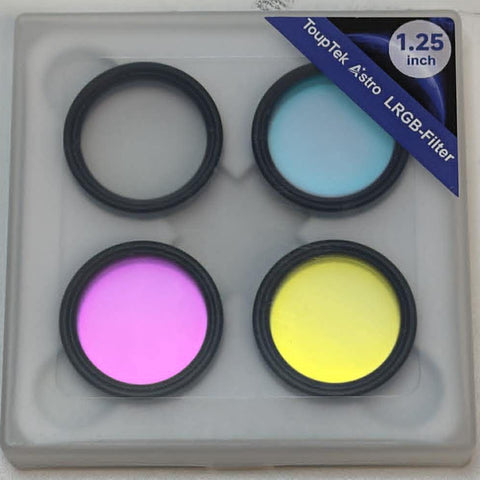
This is a complete set of 1.25" Touptek LRGB/SHO filter, seven filters total, in excellent condition with clean optics. They come in their original jewel cases. They do not include a box.
Description:
Narrowband filters are essential accessories in astrophotography used to isolate specific wavelength emission lines and enhance the signal-to-noise ratio of your target—especially for capturing breathtaking emission nebulae.
ToupTek SHO narrowband filters are precisely tuned to the three main ionized emission lines found in star-forming regions:
ToupTek SHO narrowband filters are precisely tuned to the three main ionized emission lines found in star-forming regions:
- Hα (656.3nm)
- SII (671.6nm)
- OIII (500.7nm)
By using these filters, you can effectively block urban light pollution and background stray light, dramatically enhance signal contrast, and bring out incredible detail—empowering you to achieve Hubble-like color mixing (SHO synthesis) in your astrophotography.

Technical Parameters
Size: 36mm (unframed) / 1.25” / 2”
Glass Thickness: 2mm
Transmission Range:
- H-alpha filter: Central wavelength 656.3nm
- SII filter: Central wavelength 671.6nm
- OIII filter: Central wavelength 500.7nm
Transmittance: >90%
FWHM:
- 36mm: H-alpha (4nm) / SII (4nm) / OIII (4nm)
- 1.25” & 2”: H-alpha (6.5nm) / SII (6.5nm) / OIII (6.5nm)
Glass Material: Quartz glass
Frame Material: Aluminum Alloy
Surface Treatment: Double-sided high-precision optical polishing
Coating Technology: IAD (Ion Assisted Deposition)
Coating System Design: AR anti-reflection coating + quartz glass + precision cutoff coating layer
OD: ≥5.0

Key Features
▶️ Precise Band Control & Enhanced Detail Resolution
The precise narrowband design effectively suppresses background noise while highlighting the emission structures of different elements, resulting in clearer celestial stratification and enhanced detail gradation.
▲ Hα filter: Central wavelength 656.3nm, FWHM 4nm.
Optimized for hydrogen ionization regions, this filter serves as the primary channel for capturing nebular morphology.
▲ OIII filter: Central wavelength 500.7nm (OIII emission line), FWHM 4nm.
Designed to reveal high-energy excitation zones, particularly effective for visualizing blue-green nebular details.
▲ SII filter: Central wavelength 671.6nm, FWHM 4nm.
Enhances detection of faint signals and reveals structural stratification through ionized sulfur distribution. When combined with Hα, significantly improves image contrast.
*FWHM for 1.25-inch and 2-inch filters is 6.5nm.
▲ Hα filter: Central wavelength 656.3nm, FWHM 4nm.
Optimized for hydrogen ionization regions, this filter serves as the primary channel for capturing nebular morphology.
▲ OIII filter: Central wavelength 500.7nm (OIII emission line), FWHM 4nm.
Designed to reveal high-energy excitation zones, particularly effective for visualizing blue-green nebular details.
▲ SII filter: Central wavelength 671.6nm, FWHM 4nm.
Enhances detection of faint signals and reveals structural stratification through ionized sulfur distribution. When combined with Hα, significantly improves image contrast.
*FWHM for 1.25-inch and 2-inch filters is 6.5nm.
▶️ High-Quality Quartz Glass, High Transparency and Purity
The entire series of ToupTek Astro filters utilize high-quality colorless transparent quartz glass, with >90% high transmittance, high purity, exceptional blue-violet band transmission, and outstanding thermal stability—ideal for various demanding astronomical imaging applications.
▶️ IAD Dense Coating, Durable and Stable
Using IAD (Ion Assisted Deposition) coating technology, which is more costly than conventional vacuum evaporation but produces denser and more uniform coatings that are durable, corrosion-resistant, and have superior environmental stability.
▶️ Precision Coating, Significantly Suppresses Halos
ToupTek Astro filters employ a proprietary multi-layer system: a single-sided cutoff coating, front surface AR anti-reflection coating, and edge blackening treatment. This combination effectively minimizes internal reflections and stray light while ensuring coating integrity and extended service life.
▶️ High Optical Cutoff Depth, Restores Natural Colors
All channel filters have a cutoff depth of OD≥5.0, effectively blocking non-target spectral regions, avoiding band crosstalk and color cast, resulting in accurate and natural color reproduction.
▶️ Matte Black Edge Coating, Easy Installation
The filter edge is coated with a black matte treatment to minimize stray light, which ensures transmittance, reduces glare, and enhances image contrast.
▲ 36mm filters: The telescope-facing side has an inward-extending blackened border for quick orientation identification.
▲ 1.25" & 2" filters: Feature threaded aluminum alloy frames for direct screw-in installation, ensuring fast and tool-free mounting.
▲ 36mm filters: The telescope-facing side has an inward-extending blackened border for quick orientation identification.
▲ 1.25" & 2" filters: Feature threaded aluminum alloy frames for direct screw-in installation, ensuring fast and tool-free mounting.
▶️ Highly Compatible
All filters use a single-piece, glue-free structure.
▲ 36mm: Recommended for APS-C and smaller cameras.
▲ 1.25": Recommended for cameras with a 1-inch or smaller sensor.
▲ 2": Recommended for full-frame and smaller cameras.
Compatible with various brands on the market featuring 7-hole 36mm, 8-hole 1.25-inch, and 5-hole 2-inch electric filter wheels, offering a wider range of compatibility options.
▲ 36mm: Recommended for APS-C and smaller cameras.
▲ 1.25": Recommended for cameras with a 1-inch or smaller sensor.
▲ 2": Recommended for full-frame and smaller cameras.
Compatible with various brands on the market featuring 7-hole 36mm, 8-hole 1.25-inch, and 5-hole 2-inch electric filter wheels, offering a wider range of compatibility options.

Spectrum

Spectral Chart Reading Tips:
- The horizontal axis represents the wavelength of light (in nm), and the vertical axis represents light transmittance (percentage %).
- Red line: Hα (656nm); Green line: OIII (500.7nm); Blue line: SII (672.4nm).
- Emission nebula signal bands are mainly at 656nm (Hα), 500.7nm (OIII), and similar wavelengths.
- Light pollution peaks are often found near 540nm and 590nm (sodium/mercury lamp bands).
The transmission regions of our astronomical filters are engineered to avoid these interference bands, ensuring maximum signal clarity, enhanced contrast, and high image purity for deep-sky imaging.
Why Choose LRGB Filters?
Designed to overcome light pollution, the ToupTek Astro LRGB filter set empowers astrophotographers to reveal the universe's authentic chromatic splendor.
The RGB three-channel filters are essential tools for monochrome astronomy cameras to capture professional-grade images.
ToupTek Astro LRGB filters utilize advanced optical materials and precise coating technology to selectively transmit celestial emissions while blocking urban light pollution. This brings the true colors of the starry sky vividly to life and significantly enhances image contrast.
Even faint celestial targets can reveal rich details. The extremely low halo effect ensures each image has excellent fidelity, elevating your astrophotography to the next level.
The RGB three-channel filters are essential tools for monochrome astronomy cameras to capture professional-grade images.
ToupTek Astro LRGB filters utilize advanced optical materials and precise coating technology to selectively transmit celestial emissions while blocking urban light pollution. This brings the true colors of the starry sky vividly to life and significantly enhances image contrast.
Even faint celestial targets can reveal rich details. The extremely low halo effect ensures each image has excellent fidelity, elevating your astrophotography to the next level.

Technical Parameters
Size: 36mm (unframed) / 1.25” (31.77mm) / 2”
Glass Thickness: 2mm
Transmission Range:
L (420–690nm); R (595–695nm); G (495–580nm); B (400–510nm)
L (420–690nm); R (595–695nm); G (495–580nm); B (400–510nm)
Transmittance: >95%
Glass Material: Quartz glass
Frame Material: Aluminum Alloy
Surface Treatment: Double-sided high-precision optical polishing
Coating Technology: IAD (Ion Assisted Deposition) coating technology
Coating System Design: AR anti-reflection coating + quartz glass + precision cutoff coating layer
OD: ≥5.0

Spectrum

Spectral Chart Reading Tips:
- The horizontal axis represents the wavelength of light (unit: nm), and the vertical axis represents light transmittance (unit: %).
Gray line: L channel; Red: R; Green: G; Blue: B - The emission nebula signal bands are mainly concentrated around 656nm (Hα), 500.7nm (OIII), and other bands.
- Light pollution peaks are commonly found near 540nm and 590nm (sodium/mercury lamp bands).
- The transmission regions of the astronomical filters are engineered to avoid these interference bands, ensuring effective signal passage, enhancing contrast, and image purity.
Key Features