



 Qualifies for Free Ground Economy Shipping (CONUS Only)
A smart telescope you upgrade by swapping the optics, not the whole instrument
Vaonis Atlas Notable Features:
- More aperture than any Vespera: an 80mm f/4.5 apochromatic quadruplet gathers about 2.5 times the light of the 50mm Vespera optics, with a Sony IMX585 sensor built into the same module.
- It sees the whole sky: a 185° fisheye camera in the mount shows the sky from horizon to horizon in the Gaia app, labeled with constellations and objects. Tap a target and Atlas turns to it.
- Room to grow: imaging modules clip on in under five seconds with no tools. Start with one, add a second for the Twin setup later, and use future modules on the same mount.
- Worth knowing: this is a preorder, with first deliveries expected in March 2027. It shows images on a screen, not through an eyepiece, and Vespera accessories don't fit it.
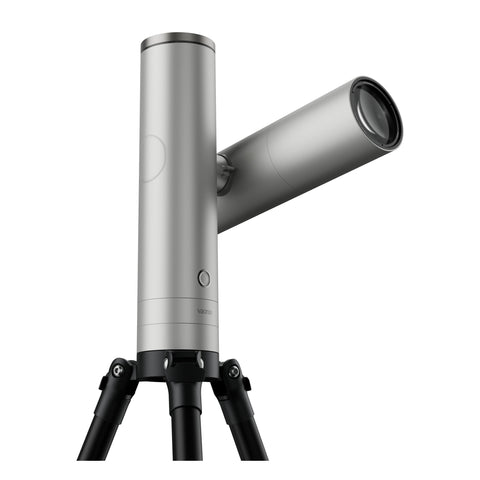
The Vaonis Atlas Modular Smart Telescope is a computerized alt-az mount with clip-on 80mm imaging modules, each one an apochromatic refractor with its own color camera. Set it on its aluminum tripod, open the Gaia app on your phone or tablet, and pick a target from the live all-sky view. Atlas points, focuses, tracks and stacks on its own, and the picture builds on your screen. It comes in two configurations: Single with one 80mm module, and Twin with two modules aimed at the same object and stacked together, for more detail in half the time. The mount weighs 3.5kg (7.7lb) and each module 3kg (6.6lb).
Key specs: 80mm f/4.5 Petzval apochromatic quadruplet, 360mm focal length · Sony IMX585 STARVIS 2 color sensor, 8.3MP, 2.9µm pixels · 1.78° × 1.00° field, mosaics up to 3.5° × 2° (24MP) · 1.66 arcsec per pixel · 185° Sky Guard all-sky camera · JPEG, 16-bit TIFF and 16-bit FITS · 6-hour replaceable battery, 60W USB-C · IP64, -20°C to +40°C
Atlas is available to preorder now. Vaonis expects first deliveries in March 2027.

What you can capture
- Emission nebulae: the Eagle Nebula (M16), the Wizard Nebula (NGC 7380), the Lagoon and Trifid Nebulae, the Orion Nebula and the Rosette Nebula fit in a single frame.
- Large nebulae with a mosaic: the Heart Nebula, the North America Nebula and sections of the Veil Nebula, using CovalENS mosaics up to 3.5° × 2°.
- Galaxies: the Triangulum Galaxy (M33), the Whirlpool Galaxy (M51), and Bode's and the Cigar Galaxies (M81 and M82). The Andromeda Galaxy fits in a mosaic.
- Dusty reflection nebulae and clusters: the Iris Nebula (NGC 7023), the Pleiades and the Double Cluster.
- The Moon and the Sun: with live video for the Moon, and for the Sun with the full-aperture solar filter (required for any solar viewing).
Vaonis's sample images include the Eagle Nebula after 68 minutes with one module, and M33 after 15 minutes with the Twin configuration. You can see them in the photo gallery above.
Sky Guard: the whole sky on your screen
A 185° fisheye camera (Sony IMX676, 12MP) in the top of the mount films the sky live from horizon to horizon, day or night, and shows stars down to about magnitude 6, roughly what your eyes see from a dark site. In the Gaia app that view becomes a live sky chart with constellations, object names and your target marked. Pick an object there and Atlas slews to it and starts imaging. You can switch between the all-sky view and the detailed image from the module at any time, and Sky Guard records a timelapse of the night while you observe.

Single or Twin
One 80mm module is a complete telescope. The second module in the Twin configuration aims at the same object at the same time, and Vaonis's Sky Twin software stacks the two image streams automatically, so you collect twice the light in the same time. Choose Twin if faint nebulae and galaxies are your priority and your clear nights are short. Choose Single if you'd like to start lower and add a second module (Vaonis part C80) later. Each module has its own sensor, motorized focus and filter drawer.
How it sets up
- Set Atlas on its tripod and level it. The LED ring and the app guide you.
- Connect your phone or tablet over NFC or Wi-Fi 6.
- Open the Gaia app. Atlas aligns itself and Sky Guard shows the whole sky.
- Pick a target. Atlas points, tracks, focuses and stacks, and the image builds live on your screen and on up to 10 other connected devices.
There's no polar alignment. Atlas ships as an alt-az mount with single exposures up to 30 seconds stacked in real time. Vaonis plans an equatorial mode in the first half of 2027 and an equatorial table accessory in the second half of 2027 for longer exposures without field rotation.
For processing, Atlas saves 16-bit FITS raw files and 16-bit TIFF stacks for Siril, PixInsight or Photoshop, and it can pick a target up again on later nights to keep adding exposure time to the same image. Storage is a microSD card (16GB included, expandable).
Built for cold nights and travel
Inside is a die-cast aluminum chassis for rigid, accurate tracking, and outside is a protective shell machined from solid aluminum. Atlas is rated IP64 against dust and splashing water and runs from -20°C to +40°C (-4°F to 104°F), which covers a Colorado winter night at altitude. A built-in humidity and temperature sensor runs the dew heater automatically. The sealed USB-C 3.1 port handles 60W fast charging and data, the 9,000mAh battery is replaceable, and the mount is designed and made in France by Vaonis in Montpellier.
What to add for the best results
- A USB-C power supply or power bank: Atlas charges at up to 60W over USB-C Power Delivery and can run from a power bank while observing for nights longer than the 6-hour battery.
- ZWO Duo-Band Ha/OIII Filter (1.25"): the filter drawer takes standard 1.25" filters, and a dual-band filter makes emission nebulae stand out from city and suburban skies.
- Vaonis Atlas filters: Vaonis CLS, Dual-band and Dark filters that Atlas detects automatically, plus a full-aperture solar filter (required for the Sun), are expected at the product's release. Ask us about adding them to your order.
- A second 80mm imaging module (C80): turns a Single into a Twin later. Vaonis will sell it separately.
Atlas Single vs. Atlas Twin vs. Vespera Pro II
| Atlas Single | Atlas Twin | Vespera Pro II | |
|---|---|---|---|
| Aperture | 80mm | 2 × 80mm | 50mm |
| Focal length | 360mm (f/4.5) | 360mm (f/4.5) | 250mm (f/5) |
| Optics | Petzval apo quadruplet | Petzval apo quadruplet × 2 | Apo quadruplet |
| Sensor | Sony IMX585, 8.3MP | 2 × Sony IMX585, 8.3MP | Sony IMX676, 12.5MP |
| Image scale | 1.66"/pixel | 1.66"/pixel | 1.65"/pixel |
| Largest mosaic | 3.5° × 2° (24MP) | 3.5° × 2° (24MP) | 4.18° × 2.45° (50MP) |
| All-sky camera | Yes, 185° | Yes, 185° | No |
| Swappable modules | Yes | Yes | No |
| Battery life | 6 hours | 6 hours with one module | 11 hours |
| Storage | 16GB microSD, expandable | 16GB microSD, expandable | 225GB |
| Warranty | 10 years mount, 5 years module | 10 years mount, 5 years modules | 5 years |
| Best for | More aperture now, with room to add a second module later | Faint nebulae and galaxies on short clear nights | A lighter, lower-cost all-in-one with a large mosaic |
See all Vaonis smart telescopes and accessories.
What's in the box
Atlas Single (ATL-C80-I):
- Atlas mount with aluminum tripod
- One Atlas 80mm imaging module with lens cap, Sky Dock cap and standard filter drawer
- Atlas mount extension
- Protective cover, plus Sky Dock and Sky Guard caps
- 16GB microSD card
- Quick start guides
Atlas Twin (ATL-C80-II): the same, with two 80mm imaging modules (each with its lens cap, Sky Dock cap and filter drawer) and two mount extensions.
Sold separately: the extra 80mm module (C80), Vaonis Atlas filters and solar filter, and the equatorial table (planned for the second half of 2027).
Vaonis Atlas FAQ
Is Atlas good for beginners?
Yes. The app walks you through leveling, and Atlas handles alignment, pointing, focusing and tracking. You choose an object in the Sky Guard view and watch the image build, with nothing to learn first.
Do you look through an eyepiece?
No. Atlas has no eyepiece. You watch the image on your phone or tablet in the Gaia app, and it gets brighter and more detailed as exposures stack, showing color the eye can't see even through a large telescope.
Single or Twin, which should I choose?
Single is a complete telescope. Twin adds a second module on the same target, which collects twice the light and reaches the same result in about half the time. If faint deep-sky objects are your main interest and your nights are short, get Twin. Otherwise start with Single and add the C80 module later.
Atlas or Vespera Pro II?
Atlas has 80mm of aperture instead of 50mm, the 185° Sky Guard camera, swappable modules and a 10-year mount warranty. The Vespera Pro II costs less, is a single sealed unit, has longer battery life and makes larger mosaics. Their image scale is almost the same.
Can I photograph Saturn and Jupiter with it?
You can capture them, but at the Atlas's fixed 360mm focal length, the planets are very small (given the specs here, Mile High Astronomy estimates about 25 pixels for Jupiter or Saturn on average). Atlas is made for nebulae, galaxies, star clusters, the Moon and, with the solar filter, the Sun. Vaonis is developing a planetary module for the same mount.
Can I use it from the city?
Yes. Live stacking brings out deep-sky objects from light-polluted skies, and a light-pollution or dual-band filter in the filter drawer helps even more on nebulae.
Are Vespera accessories compatible?
No. Atlas is a new platform, and Vespera filters, tripods and other accessories don't fit the Atlas mount or the 80mm module.
How long does the battery last?
About 6 hours with one module. It charges over USB-C at up to 60W, can run from a power bank during long nights, and the battery is replaceable.
Does it take long exposures?
At launch, Atlas runs in alt-az mode with exposures up to 30 seconds (usually less), stacked live, which works for most deep-sky targets. Vaonis plans an equatorial mode in the first half of 2027 and an equatorial table in the second half of 2027 for longer exposures.
When will it ship?
Atlas is a preorder. Vaonis expects first deliveries in March 2027.
Specifications
| Optics (each 80mm imaging module) | |
|---|---|
| Design | Corrected Petzval apochromatic quadruplet, 4 elements in 3 groups |
| Glass | 2 fluorophosphate (ultra-low dispersion) elements, 1 lanthanum element |
| Aperture | 80mm |
| Focal length | 360mm (f/4.5) |
| Optical quality | Diffraction-limited across the full field and visible spectrum |
| Focusing | Automatic, motorized stepper focus |
| Dew shield | Built in, retractable |
| Camera | |
| Sensor | Sony IMX585 STARVIS 2, color, back-illuminated |
| Resolution | 3840 × 2160 (8.3MP) |
| Sensor format | 1/1.2" (11.2 × 6.3mm) |
| Pixel size | 2.9µm (1.66 arcsec per pixel) |
| Field of view | 1.78° × 1.00°; CovalENS mosaic up to 3.5° × 2° (24MP) |
| Image formats | JPEG 8-bit, TIFF 16-bit, FITS 16-bit |
| Modes | Deep sky, Moon, planets, Sun (with solar filter), daytime, multi-night, mosaic, night timelapse |
| Mount and electronics | |
| Mount | Computerized alt-azimuth; equatorial mode with the equatorial table (planned second half of 2027) |
| Imaging modules | 1 or 2 × 80mm modules on Sky Dock tool-free connectors, locked in under 5 seconds |
| Drive | Stepper motors with 1/256 microstepping, belt and worm gear, slewing up to 6° per second |
| Sky Guard camera | Sony IMX676 STARVIS 2, 12MP at 10fps, 185° fisheye, stars to about magnitude 6 |
| Leveling | Accelerometer and LED ring, guided in the app |
| Dew control | Humidity and temperature sensor with automatic dew heating |
| Storage | 16GB microSD included, expandable; 32GB system memory |
| Wireless | Wi-Fi 6 2×2 MIMO, NFC, Bluetooth 5.2; more than 10 simultaneous users |
| Port | Sealed USB-C 3.1 (IP68), 60W USB-PD charging and data; Ethernet and USB accessories via adapter |
| Battery | 9,000mAh Li-ion, replaceable; about 6 hours with one module |
| App | Vaonis Gaia for iOS and Android |
| Filters | |
| Filter drawer | Standard 1.25" (31.75mm) filters; Vaonis CLS, Dual-band and Dark filters detected automatically |
| Physical | |
| Dimensions | Single: 41 × 10 × 20.5cm; Twin: 41 × 10 × 31cm |
| Weight | Mount 3.5kg (7.7lb); each 80mm module 3kg (6.6lb) |
| Construction | Die-cast aluminum inner chassis, machined aluminum outer shell |
| Weather rating | IP64 (dust and water splashes) |
| Operating temperature | -20°C to +40°C (-4°F to 104°F) |
| Warranty and model | |
| Warranty | 10 years on the mount, 5 years on each imaging module |
| Made in | Mount designed and made in France (Montpellier); module designed in France, made in China |
| Model / SKU | Vaonis Atlas Single (ATL-C80-I); Vaonis Atlas Twin (ATL-C80-II) |