





Yes, our inventory is accurate!
 Qualifies for Free Ground Economy Shipping (CONUS Only)
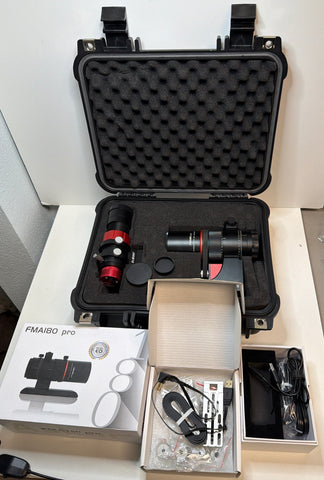
This is a nice complete astrophotography rig that's all set up for you to do your widefield AP. This is the Askar FMA180 Pro. It includes a SvBony SV165 30mm guidescope (a $69 value), the ASI120MM guide camera (a $199 value), the ZWO EAF (a $199 value), with Askar autofocus kit for FMA180 Pro, including the bracket to hold the EAF on the rig (a $92 value). Everything is in excellent condition, with clean optics/sensors, and bodies. Just attach your own camera (at the time of listing, the used ASI585MC Pro that came with this rig is being sold separately), and you're in business.
Comes in its original soft-sided foam-lined case. This includes the original boxes and additional mounting accessories/parts for the FMA180, the ZWO EAF, and the ASI120MM.
This is over $1000 worth of gear for just $675! Get it while it lasts!
A palm-sized astrograph for huge fields of sky
Why we like the Askar FMA180 Pro:
- Sharp across a big sensor: six air-spaced elements, two of them ED glass, cover a 44mm image circle, so a full-frame or APS-C camera gets round stars to the corners at f/4.5 with no flattener to add.
- Tiny and light: 167.5mm (6.6") long and 0.8kg (1.8lb) with its dovetail base, it rides on a star tracker or a small GoTo mount and fits in a camera bag.
- Two jobs in one: take off the Vixen dovetail and its base fits a telescope's finder base, so the FMA180 Pro can serve as a 180mm guide scope on a bigger telescope.
- Worth knowing: a 40mm aperture collects light slowly even at f/4.5, so plan on long total exposures, and small galaxies come out tiny at 180mm. It's built for cameras; Askar doesn't include an eyepiece adapter.
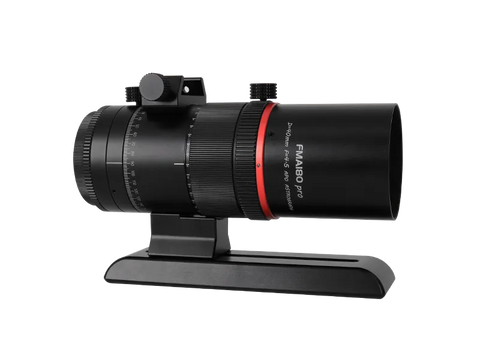
The Askar FMA180 Pro is a 40mm f/4.5 apochromatic astrograph with a 180mm focal length. Its sextuplet objective (three elements in front, three in the rear, including two ED elements) has the field correction built in, and an M48 thread with a built-in 2" filter thread sets the camera at the standard 55mm back focus. Compared with the original FMA180, the Pro adds an internal focuser, a 360° rotator and a finder base on top. With an APS-C camera it frames about 7.5° × 5°, wide enough for the whole Orion complex or the North America and Pelican Nebulae with room around them.
Key specs: 40mm aperture · 180mm focal length, f/4.5 · air-spaced sextuplet APO with two ED elements · 44mm (full-frame) image circle · 55mm back focus, M48 × 0.75 with built-in 2" filter thread · internal focuser · 360° rotator · finder base · 0.8kg (1.8lb) with 150mm Vixen dovetail base

What you can image
- Whole nebula complexes: the Orion Nebula with the Horsehead and Flame Nebulae, the Heart and Soul Nebulae together, the North America and Pelican Nebulae, the California Nebula and the Cygnus Milky Way around Sadr.
- Faint, sprawling targets: the Spaghetti Nebula, Barnard's Loop and the region around IC 443 and M35, targets that show up in Askar's own FMA180 Pro sample images.
- Big galaxies and clusters: the Andromeda Galaxy with plenty of sky around it, the Pleiades and the Double Cluster.
- Comets and Milky Way fields: the wide field leaves room for long comet tails and dense star clouds.
With a 26MP APS-C camera such as the ZWO ASI2600MC Air the FMA180 Pro works at 4.3 arcseconds per pixel, so small tracking errors don't show. That makes it a forgiving first astrograph.

How it works
Optics: the rear three elements act as a built-in field corrector, so there's nothing to add between the telescope and the camera except the right spacing. Thread your camera onto the M48 × 0.75 thread and set the sensor 55mm behind it, which most astronomy cameras do with their included spacers.
Focusing: the internal focuser moves the optics inside the tube, with a scale ring so you can return to the same focus point. The Askar FMA180 Pro AF kit connects an electronic focuser for autofocus, and includes a timing belt and pulley that suit the ZWO EAF Pro.
Framing and filters: the 360° rotator turns the camera to frame a target, and a 2" filter threads into the rear of the telescope.
Mounting: the base has a 150mm Vixen-style dovetail. Remove the dovetail and the base fits onto another telescope's finder base, so it can ride piggyback on a larger telescope as a guide scope, and the finder base on top takes a small guide scope or red-dot finder.
What to add for the best results
- A mount (required): the Sky-Watcher Star Adventurer GTi finds targets for you and carries it easily. The iOptron SkyGuider Pro tracker also works, with a sturdy tripod such as the iOptron 1.25" tripod.
- A camera: the ZWO ASI2600MC Air (7.5° × 5.0°) has a guide sensor and ASIAIR built in, so it needs no separate guide scope or controller. The ASI2600MC Pro or ASI533MC Pro (3.6° × 3.6°) work well too, and a DSLR or mirrorless camera connects with an M48 T-ring.
- Control: with a camera other than the Air, the ZWO ASIAIR Plus runs capture, guiding and focus from your phone.
- Autofocus: the FMA180 Pro AF kit with a ZWO EAF Pro focuser.
- Filters: a 2" ZWO Duo-Band or Optolong L-eXtreme for emission nebulae from light-polluted skies.
- Field power: a Celestron PowerTank Lithium Pro for a cooled camera away from an outlet.
FMA180 Pro vs. other small Askar astrographs
| FMA180 Pro | Askar 50P | Askar SQA55 | Askar 60F | |
|---|---|---|---|---|
| Aperture / focal length | 40mm, 180mm f/4.5 | 50mm, 190mm f/3.8 | 55mm, 264mm f/4.8 | 60mm, 408mm f/6.8 |
| Image format | Full frame (44mm) | APS-C | Full frame (44mm) | Full frame (44mm) |
| Field with APS-C (ASI2600MC) | 7.47° × 4.99° | 7.08° × 4.73° | 5.09° × 3.40° | 3.30° × 2.20° |
| Weight with base or rings | 0.8kg (1.8lb) | 1.4kg (3.1lb) | 2.18kg (4.8lb) | 2.86kg (6.3lb) |
| Best for | The smallest kit, or a guide scope later | A faster wide field on APS-C | Full-frame wide-field imaging | Imaging plus visual use |
See all Askar telescopes.
What's in the box
- Askar FMA180 Pro optical tube with Vixen dovetail base
- Instruction manual
The mount, camera, filters, AF kit and focuser motor are sold separately.
Askar FMA180 Pro FAQ
Is the FMA180 Pro good for beginners?
Yes. At 180mm it's very forgiving of tracking and polar alignment errors, it needs no flattener, and it's light enough for a star tracker. It's one of the easiest ways to move from a camera lens to a real astrograph.
Which camera works best?
An APS-C camera such as the ASI2600MC Air or ASI2600MC Pro makes the most of the wide field. The 44mm image circle also covers full-frame sensors.
Can I use it as a guide scope?
Yes. Remove the Vixen dovetail and the base fits onto the finder base of a larger telescope, giving you a 180mm guide scope for a guide camera.
FMA180 Pro or 50P?
Both frame about 7° × 5° with APS-C. The 50P has more aperture and a faster f/3.8, so it gathers light quicker, but it's designed for APS-C and smaller sensors. The FMA180 Pro is lighter, covers full frame and doubles as a guide scope.
Can I use it for visual observing?
Askar optimized it for astrophotography and supplies no eyepiece adapter, so we recommend it for cameras. For viewing as well as imaging, the Askar 60F comes with visual adapters.
What mount do I need?
With a camera it weighs about 1.5kg (3.3lb), well within the capacity of a star tracker such as the SkyGuider Pro or a small GoTo mount like the Star Adventurer GTi.
Specifications
| Optics | |
|---|---|
| Optical design | Air-spaced sextuplet APO (three front elements, three rear), two ED elements |
| Aperture | 40mm |
| Focal length | 180mm |
| Focal ratio | f/4.5 |
| Image circle | 44mm (full frame) |
| Back focus | 55mm |
| Mechanical | |
| Camera thread | M48 × 0.75 with built-in 2" filter thread |
| Focuser | Internal focusing with scale |
| Rotator | 360° |
| Mounting | Base with 150mm Vixen-style dovetail (removable; base fits a finder base); finder base on top |
| Physical | |
| Length | 167.5mm (6.6") |
| Tube diameter | 58mm |
| Height with base | 109mm |
| Weight | 0.8kg (1.8lb) with dovetail base |
| Model | Askar FMA180 Pro |