



 Qualifies for Free Ground Economy Shipping (CONUS Only)
A 4.4-inch flat-field refractor that frames galaxies and nebulae and doubles as a visual scope
Why we like the Askar 111F:
- Flat field without the fuss: the quadruplet's rear element flattens the field across a full-frame sensor (44mm image circle), so there's no separate flattener to buy and no exact back-focus spacing to hit.
- A useful focal length: 766mm frames the Andromeda Galaxy's core, the Horsehead and Flame Nebulae together, or M81 and M82 side by side on an APS-C camera, at about 1″ per pixel.
- One telescope for both hobbies: 1.25" and 2" visual adapters are built into the focuser, so it switches from camera to eyepiece in a minute for color-free views of the planets and the Moon.
- Worth knowing: at 6.76kg (14.9lb) with rings and plate and 728mm long with the camera adapter, it wants a mount like the ZWO AM5N, not a small tracker. At f/6.9 it is slower than an f/5 astrograph, so plan on longer total exposures.
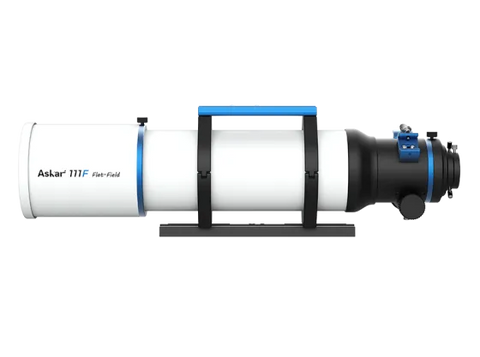
The Askar 111F Flat-Field is a 111mm f/6.9 air-spaced quadruplet APO refractor with one ED element, three lenses up front and one at the rear. It covers a full-frame sensor with no added flattener and comes with a 3" dual-speed rack-and-pinion focuser, a 360° rotator, a retractable dew shield, an internal baffle against stray light, two finder bases at the focuser and a handle with a third. It sits between the portable 91F and the big 131F: enough aperture and focal length for galaxies, still a manageable size to carry out to the yard.
Key specs: 111mm aperture · 766mm focal length · f/6.9 · quadruplet air-spaced APO with 1 ED element · 44mm image circle, no flattener needed · 3" rack-and-pinion focuser, 1:10 fine focus · 6.76kg (14.9lb) with rings, handle and 300mm Vixen plate

What you can image and see
- Galaxies: M81 and M82 together, the Triangulum Galaxy (M33), the Whirlpool (M51), the Leo Triplet and the bright core of the Andromeda Galaxy with M32.
- Nebulae: the Horsehead and Flame Nebulae in one frame, the Orion Nebula and Running Man, the Crescent Nebula, the Eagle Nebula, the Jellyfish Nebula (IC 443) and the Pacman Nebula.
- Clusters and planetary nebulae: the Hercules Cluster (M13), the Dumbbell Nebula (M27) and the Helix Nebula.
- At the eyepiece: Saturn's rings, Jupiter's belts and moons, lunar detail at high power, and the whole Pleiades cluster at low power.
Fields of view at 766mm: 2.69° × 1.80° with a full-frame sensor, 1.76° × 1.17° with an APS-C camera such as the ASI2600MC Pro (1.01″ per pixel), and 0.85° × 0.85° with the ASI533MC Pro.

How it works
Imaging: the included photographic extension tubes thread onto the focuser and end in an M54 × 0.75 or M48 × 0.75 male thread, with a 2" filter thread built in. Because the 111F flattens its own field, spacing isn't critical: the sensor can sit anywhere from 43 to 73mm behind the M48 thread (61 to 91mm behind the M54 thread) and still reach focus. That leaves room for a filter drawer, filter wheel or off-axis guider in front of the camera.
Visual: use the built-in 2" or 1.25" adapter with a diagonal and eyepiece. A 2" 35mm wide-field eyepiece gives about 22x and a field near 3°; a 10mm eyepiece gives about 77x.
Focusing and framing: the dual-speed focuser's 1:10 fine knob has a protective cap, and the graduated 360° rotator turns the camera to frame a target. A ZWO EAF mounts in place of the coarse focus knob with a 5 to 6mm flexible coupling, as Askar's assembly diagram shows.
Mounting: the 300mm Vixen-style plate has 1/4" and 3/8" threaded holes, fits standard Vixen saddles and can go straight onto a heavy photo tripod for daytime use.
What to add for the best results
- A mount (required): the ZWO AM5N with TC40 tripod carries 15kg (33lb) without a counterweight, plenty for the 111F, a camera and a guider.
- A camera: the ZWO ASI2600MC Pro, the ASI2600MC Air with built-in ASIAIR and guider, or the ASI2600MM Pro with ZWO 7nm SHO filters for mono narrowband.
- Guiding: the Askar 52mm Super ED guide scope on a finder base with an ASI220MM Mini, or a ZWO OAG in the imaging train.
- Autofocus: the ZWO EAFN or EAF Pro.
- Filters: a 2" Askar Colour Magic C1 (Hα + OIII) threads into the extension tube, or use a ZWO M54 filter drawer to swap filters without removing the camera.
- For visual use: a 2" diagonal such as the Explore Scientific 2" diagonal and eyepieces from our eyepiece collection.
Askar F-series comparison
| 60F | 71F | 91F | 111F | 131F | |
|---|---|---|---|---|---|
| Aperture / focal length | 60mm / 408mm, f/6.8 | 71mm / 490mm, f/6.9 | 91mm / 609mm, f/6.7 | 111mm / 766mm, f/6.9 | 131mm / 983mm, f/7.5 |
| Field, APS-C sensor | 3.30° × 2.20° | 2.75° × 1.84° | 2.21° × 1.48° | 1.76° × 1.17° | 1.37° × 0.92° |
| Focuser | 2.4" R&P, 50mm travel | 2.4" R&P, 50mm travel | 3" R&P, 30mm travel | 3" R&P, 30mm travel | 3" R&P, 30mm travel |
| Length (camera adapter, shield retracted) | 336mm | 415mm | 550mm | 728mm | 941mm |
| Weight with rings and plate | 2.86kg (6.3lb) | 3.0kg (6.6lb) | 4.52kg (10.0lb) | 6.76kg (14.9lb) | 9.4kg (20.7lb) |
| Dovetail | 230mm Vixen | 230mm Vixen | 230mm Vixen | 300mm Vixen | 300mm Losmandy |
| Best for | Travel and the biggest nebulae | Light setups and wide fields | The all-rounder | Galaxies on a mid-size mount | Small galaxies, planetary nebulae and planets |
All five share the same 44mm full-frame image circle and self-flattened quadruplet design. See all Askar telescopes.
What's in the box
- Askar 111F Flat-Field optical tube with retractable dew shield and front cap
- Pair of tube rings with handle bar
- 300mm Vixen-style dovetail plate
- Set of photographic adapters (extension tubes with M54 and M48 threads and a 2" filter thread)
- 1.25" and 2" visual adapters
A mount, camera, diagonal, eyepieces and finder are sold separately.
Askar 111F FAQ
Is the 111F good for beginners?
For visual observing, yes: it's a straightforward refractor that needs no collimation. For imaging, it's a good second telescope. At 766mm, guiding has to be decent, so if you're just starting, the 91F or 71F is more forgiving.
111F or 91F?
The 111F gathers about 49% more light and has 26% more focal length for galaxies and smaller nebulae. The 91F weighs 2.24kg less, is 178mm shorter and frames bigger targets, such as the whole Andromeda Galaxy on a full-frame camera.
111F or 131F?
The 131F adds aperture and reaches 983mm for small targets, but it weighs 9.4kg and needs a Losmandy saddle. The 111F is the one most mid-size mounts handle comfortably.
Can I see Jupiter and Saturn?
Yes. With a 2" diagonal and a short eyepiece, the 111F shows Saturn's rings and Jupiter's belts and moons sharply, and you can push to about 200x on steady nights.
Do I need a flattener or reducer?
No flattener is needed. Askar makes a 0.74x reducer for the 111F that brings it to about 567mm for a wider, faster field; ask us about availability.
Specifications
| Optics | |
|---|---|
| Optical design | Quadruplet air-spaced APO (3 front elements, 1 rear), 1 ED element; self-flattened; internal baffle |
| Aperture | 111mm |
| Focal length / ratio | 766mm / f/6.9 |
| Image circle | 44mm (full frame) |
| Imaging focus range | 43–73mm from the M48 × 0.75 thread; 61–91mm from the M54 × 0.75 thread |
| Visual focus range | 102–132mm from the 1.25" holder; 112–142mm from the 2" holder |
| Mechanical | |
| Focuser | 3" dual-speed rack and pinion, 1:10 fine focus, 30mm travel, 360° graduated rotator |
| Rear threads | M78 × 1 to M54 × 0.75; M54 × 0.75 extension; M54 × 0.75 to M48 × 0.75 with 2" (M48) filter thread |
| Dovetail | 300mm Vixen-style with 1/4" and 3/8" holes |
| Accessory mounts | Finder base on the handle, two finder bases at the focuser |
| Physical | |
| Length, 1.25" adapter | 664mm (dew shield retracted) to 751mm (extended) |
| Length, photographic adapter | 728mm (dew shield retracted) to 815mm (extended) |
| Weight | 5.74kg (12.7lb) tube; 6.76kg (14.9lb) with rings and dovetail plate |
| Model / SKU | Askar 111F Flat-Field / 111F |