



Yes, our inventory is accurate!
 Qualifies for Free Ground Economy Shipping (CONUS Only)
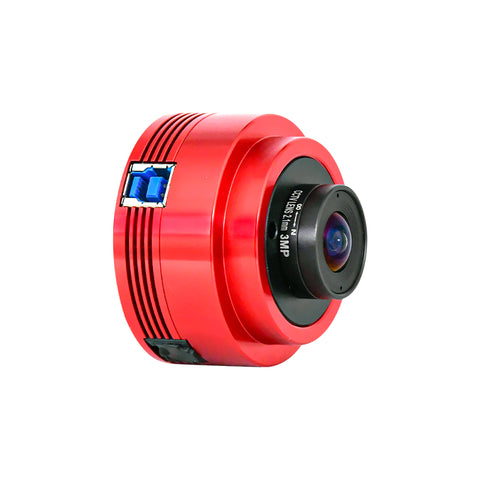
The ZWO ASI715MC is a compact, affordable color astronomy camera for high-resolution planetary and lunar imaging. Its Sony IMX715 Starvis sensor pairs tiny 1.45µm pixels with just 0.72e read noise, so it records fine detail on Jupiter, Saturn, Mars and the Moon at shorter focal lengths than cameras with larger pixels. It is also a capable camera for lucky imaging of small deep-sky targets and for autoguiding.
Key Features
- 8.46 megapixel Sony IMX715 sensor (1/2.8", 5.6 × 3.2mm, 3864 × 2192) for detailed lunar and planetary frames
- 1.45µm pixels resolve fine detail without long Barlow chains, often at your telescope's native focal ratio
- 0.72e read noise and 80% peak QE for clean, bright frames at the short exposures planetary imaging needs
- Up to 45 frames per second at full resolution, faster with a smaller region of interest, to freeze atmospheric seeing
- USB 3.0 with 256MB DDR3 buffer for stable, dropped-frame-free video capture
- ST4 guide port so it can double as an autoguiding camera
- 1.25" nosepiece included: fits any telescope focuser or diagonal that accepts 1.25" eyepieces
What It's Best For
- Planets: Jupiter's cloud belts and Great Red Spot, Saturn's rings, Mars surface features
- The Moon: high-resolution close-ups of craters and mountain ranges, or mosaics of the whole disk
- Small deep-sky objects: lucky imaging of planetary nebulae, globular clusters and bright galaxy cores
- Autoguiding: a sensitive, small-pixel guide camera for a guide scope or off-axis guider
Specifications
| Sensor | Sony IMX715 color CMOS |
|---|---|
| Sensor size | 1/2.8" (5.6 × 3.2mm) |
| Resolution | 3864 × 2192 (8.46MP) |
| Pixel size | 1.45µm |
| ADC | 12-bit |
| Read noise | 0.72e |
| Full well | 6.03ke |
| Peak QE | 80% |
| Max frame rate (full resolution) | 45.1 fps |
| Interface | USB 3.0, 256MB DDR3 buffer |
| Guide port | ST4 |
| Cooling | Uncooled |
In the Box
- ZWO ASI715MC color camera
- 1.25" nosepiece
- USB 3.0 cable (2m)
- ST4 guide cable
- Lens cover
- Quick start guide
Frequently Asked Questions
What telescope works best with the ASI715MC?
For planets, a good rule of thumb is a focal ratio of about five times the pixel size, which is roughly f/7 for this camera. That means Schmidt-Cassegrain telescopes at their native f/10 and Maksutov-Cassegrains work well with little or no Barlow, and faster refractors and Newtonians reach the right image scale with a 2x Barlow.
How is the ASI715MC different from the ASI662MC and ASI678MC?
All three are uncooled color planetary cameras. The ASI715MC has the smallest pixels (1.45µm) and the highest resolution on a 1/2.8" sensor, so it resolves detail at shorter focal lengths. The ASI662MC has larger 2.9µm pixels and a 2MP sensor, which suits longer focal lengths and very fast frame rates. The ASI678MC has 2µm pixels on a larger 1/1.8" sensor for a wider field, useful for lunar and solar-disk imaging.
Can I use the ASI715MC for deep-sky imaging?
It works well for lucky imaging of small, bright deep-sky objects using many short exposures. For long-exposure deep-sky imaging of nebulae and galaxies, a cooled camera with a larger sensor, such as the ASI533MC Pro or ASI2600MC Pro, is a better choice.
Can I use it as a guide camera?
Yes. It has an ST4 port and works with ASIAIR and PHD2. Its small pixels give fine guiding resolution on a short guide scope.
Does it work with the ASIAIR and my computer?
Yes. It is supported by the ZWO ASIAIR, and by capture software such as ASICap, SharpCap and FireCapture.
What software do I need to process planetary video?
Capture short videos, then stack the sharpest frames in free software such as AutoStakkert! and sharpen the result in RegiStax or a similar program.